“Not Me, I’m Careful.” Your Social Security Number Is Still for Sale for $1.
Careful online? Your information may be for sale anyway. See what crooks pay, what they do with it, and how to check for free what’s out there about you.

· Updated
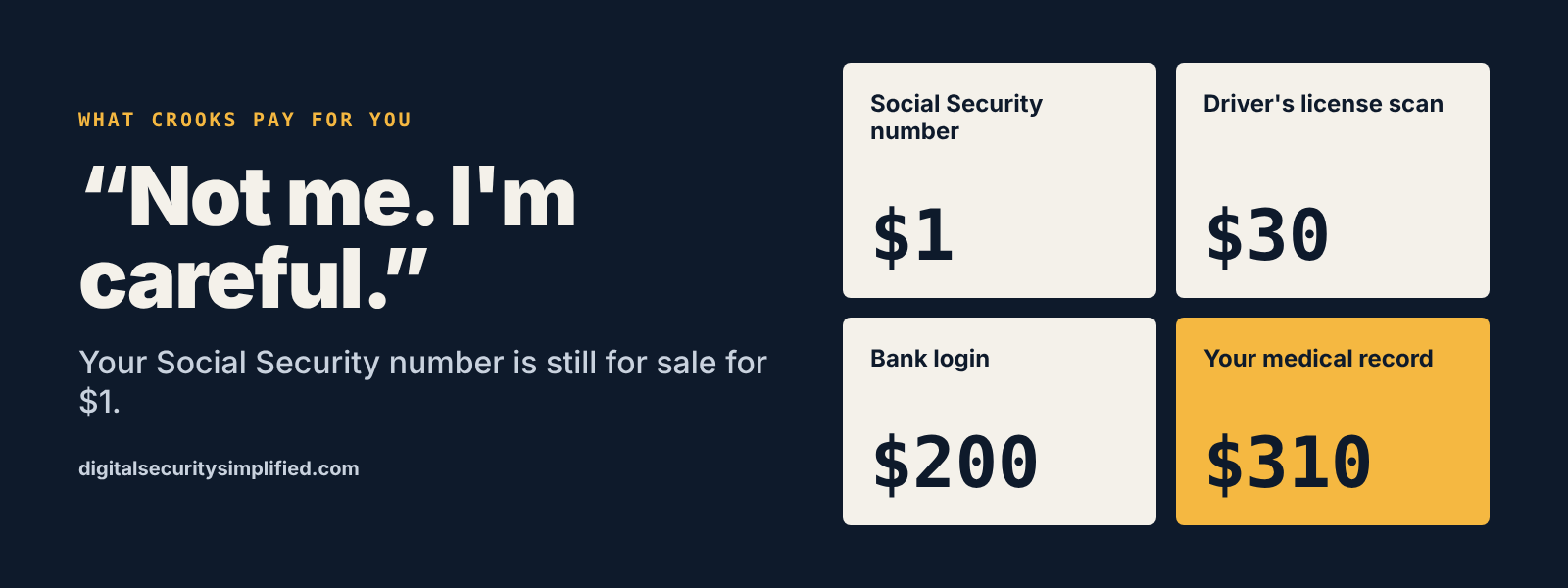
“Not me. I’m careful online.”
That’s what I’d have told you. I don’t click strange links. I don’t answer calls from numbers I don’t know. I shred the mail. I’ve got a password on everything.
Then I found out what crooks pay for a Social Security number on the dark web.
About a dollar.
The cheap price wasn’t what stopped me. It was the reason it’s so cheap. My number isn’t for sale because I slipped up. It’s for sale because somebody else did.
Here’s the menu, and you’re on it
A security company called SOCRadar keeps track of what criminals pay for stolen information in hidden online markets. Its 2026 report reads like a price list at a garage sale:
- Your Social Security number: as little as $1
- A scan of your driver’s license: $30 to $60
- Your online banking login: $200 and up, past $1,000 if the account is healthy
- Your medical record: up to $310
Why is your Social Security number cheaper than a cup of coffee? Because there are so many of them out there. Big data breaches have dumped hundreds of millions of them onto these markets. When something is everywhere, it’s cheap.
So what does a crook actually do with it?
A price tag is one thing. Here’s what each one buys a criminal, and what it can cost you.
Your Social Security number ($1). This is the master key. With your Social Security number plus your name and birthday (all of which are also cheap), a crook can:
- Open credit cards, car loans and phone accounts in your name
- File a tax return as you and grab your refund before you file
- Set up an online Social Security account in your name and try to redirect your benefits
- Get a job, rent an apartment or collect unemployment as you, which can show up later as income you never earned
- Mix your real number with a made-up name to build a brand-new fake person. That one is hard to catch, because the bills go to someone who doesn’t exist, and the trail leads back to your number.
A scan of your driver’s license ($30). A license scan is the crook’s way of saying “it’s really me.” Banks, phone companies, rental counters and online lenders all ask you to snap a photo of your license to prove who you are. A stolen scan is a real photo of a real license, so it can pass those checks. With it, a crook can:
- Open bank accounts and borrow money online, where nobody sees their face
- Back up the Social Security number they already bought, so the fake application looks complete
- Talk their way past a customer service rep (“I can send you a copy of my license”)
- Make your name stick to their traffic stops or other trouble
A stolen scan stays useful to crooks for years, until the license expires. More on where millions of them just came from in a minute.
Your bank login ($200 and up). This one is just what it sounds like. A crook signs in as you and moves your money out with transfers, Zelle or new payees, often in the middle of the night. Many first change your email or phone on the account, so the bank’s warning goes to them, not you. Some use your account to pass along money stolen from other people, which can get your account frozen while the bank sorts it out. That’s why a healthy balance pushes the price past $1,000.
Your medical record (up to $310). This is the one that surprised me. Why would a crook want to know about my knee surgery?
They don’t care about your knee. They care about what your record unlocks: your Medicare or insurance number, your doctors, your prescriptions and your Social Security number, all in one place. And unlike a credit card, you can’t cancel any of it. That’s why it’s worth 300 times more than your Social Security number. With it, a crook can:
- Get medical care on your insurance. Surgery, ER visits, hospital stays. One fake procedure can run tens of thousands of dollars, billed to you.
- Fill prescriptions in your name, especially painkillers they can resell on the street.
- Bill Medicare for things you never got: wheelchairs, back braces, diabetic supplies, lab tests.
- Use up your coverage. You could be told you’ve hit a limit, or that a service was already paid for, when you actually need it.
- Threaten to publish it. Some crooks blackmail patients over private health details.
Here’s the part that worries me most. When a stranger gets treated under your name, their information lands in your medical chart: their blood type, their allergies, their diagnoses. The next time you’re in the ER, a doctor could be reading someone else’s history. Fixing your records takes time. You’ll need to ask every doctor, hospital, lab and insurer involved to correct them, in writing.
Warning signs of medical identity theft:
- A bill or Medicare Summary Notice for care you didn’t get
- A call from a collection agency about a medical debt you don’t recognize
- A pharmacy or doctor’s office mentioning a visit or prescription that wasn’t yours
- Being turned down for care because a benefit was “already used”
See something like that? Call your insurer, or 1-800-MEDICARE if you’re on Medicare. To report Medicare fraud directly, call the HHS Office of Inspector General at 1-800-447-8477.
“But I didn’t do anything wrong”
You probably didn’t. That’s the hard part.
Your information lives in dozens of places you don’t control: your doctor’s office, your pharmacy, your bank, your insurance company, the DMV, every store with your credit card on file. When one of them gets hacked, your information walks out the door with everybody else’s.
Here’s one from just this fall. If you’ve rented a car, the counter clerk probably scanned your driver’s license. In September, ID-checking company IDScan confirmed hackers got into its systems. The criminals claimed to have more than 153 million license scans. I’ve rented cars. Have you?
So being careful still matters. It just doesn’t cover everything. Even careful people let their guard down sometimes. A tired evening, an email that looks exactly like your bank’s, a phone call that sounds urgent. Crooks count on that one moment.
Is there a way to find out what’s known about you?
Yes, at least part of it, and you can do it for free this afternoon. No free tool sees the whole dark web. But these show what’s turned up in known data breaches, which is what crooks are buying.
- Check your email at Have I Been Pwned. Type in your email address. No sign-up. It lists every known breach your email showed up in, and what was taken with it, like passwords or phone numbers. Don’t be surprised if you’re on there. Most of us are.
- Run Experian’s free dark web scan. It checks your Social Security number, email and phone number one time. You’ll need to create a free Experian account and answer a few questions to prove it’s you. No credit card required.
- Pull your credit reports at AnnualCreditReport.com. They’re free every week from all three bureaus. Look for any account or loan you don’t recognize. This is the best way to see if someone has used your information, not just found it.
- Search yourself on Google. Google’s free “Results about you” tool finds your phone number and home address in search results and lets you ask Google to remove them.
You may remember Google’s free “dark web report.” Google shut it down in February 2026, so don’t go looking for it.
Found yourself on the list? Here’s what to do
First, don’t panic. Being in a breach isn’t the same as being robbed. It means it’s time to lock the doors.
- Change the password for any account that showed up, starting with your email and your bank. Use a different password for each one.
- Turn on two-step sign-in for your email and bank. That’s the code they text you. Even with your password, a crook can’t get in without it.
- Freeze your credit at Equifax, Experian, TransUnion and Innovis. It’s free, it takes about 20 minutes, and it stops anyone from opening new accounts in your name. You can lift it for a day when you need a loan.
- Get an IRS Identity Protection PIN at IRS.gov/ippin, so nobody files a tax return as you.
- Read your Medicare Summary Notices. Look for doctors you never saw and equipment you never got.
My rule: I can’t keep my information off the dark web. I can make it worthless to whoever buys it.
If someone has already used your information
No shame here. These crooks are good at what they do, and it happens to careful people every day.
- Go to IdentityTheft.gov, the FTC’s site. It walks you through a recovery plan, step by step.
- Report it to the FBI at IC3.gov.
- Call the AARP Fraud Watch Network Helpline at 1-877-908-3360. It’s free and open to anyone, member or not.
- If you’re 60 or older, the National Elder Fraud Hotline at 1-833-372-8311 has real people who’ll help.
The bottom line
You can’t get your information back off the dark web. Nobody can. What you can do is make it worthless to the crook who buys it, and find out early if someone tries.
Being careful online is a good start. Checking up on yourself is the next step.
Where I got this: SOCRadar’s Dark Web Price Index 2026, BleepingComputer’s report that IDScan confirmed the breach tied to 153 million driver’s licenses, Google’s notice ending its dark web report, Experian’s free dark web scan, and the Wisconsin consumer protection fact sheet on medical identity theft.
Pass it on: Know someone who says “not me, I’m careful”? Send them this. It takes 20 minutes to check, and it might save them months of cleanup.